I'm a PhD Candidate in Computer Engineering at Polytechnique Montréal and Mila - Quebec AI Institute, supervised by Prof. Bentley Oakes. I hold a Diplôme d'Ingénieur from Centrale Nantes and a Master of Applied Science in Computer Engineering from Polytechnique Montréal.
My research focuses on Digital Twin Engineering. I investigate how to accelerate the engineering of trustworthy and explainable Digital Twins using a neuro-symbolic AI approach.
My broader research interests include world models, robotics and simulation, 3D visualization, human-computer interaction, and XR/virtual reality. You can find some of my work in my projects.
News
2026
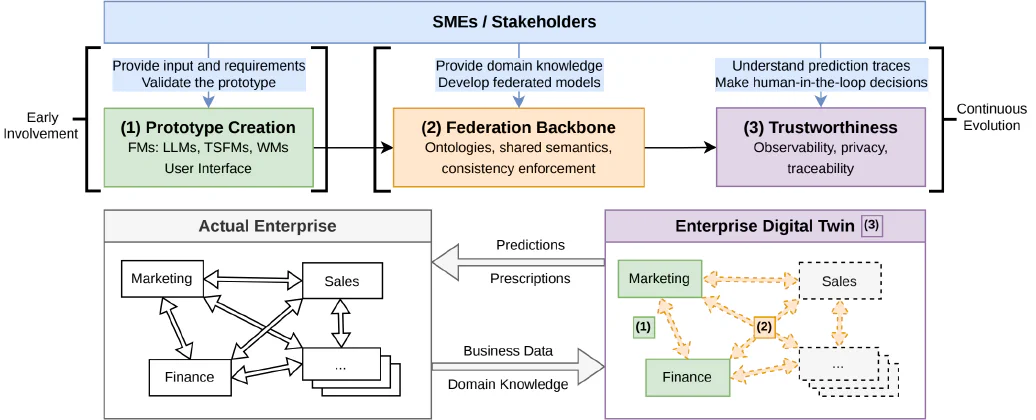
- 2026-10-06 We won the Best Extended Abstract Award for our paper Involving before Evolving: A Vision for Trustworthy Enterprise Digital Twin Engineering
- 2026-10-02 I attended the 2nd International School on Foundations and Advances of Model-Based Engineering (FAME 2026) in Málaga, Spain
- 2026-09-25 I completed the double degree program between Polytechnique Montréal and Centrale Nantes, obtaining both a Master of Applied Science in Computer Engineering and a Diplôme d’Ingénieur
- 2026-08-04 Our paper Involving before Evolving: A Vision for Trustworthy Enterprise Digital Twin Engineering has been accepted at the 3rd International Conference on Engineering Digital Twins (EDTconf 2026), co-located with 29th International Conference on Model Driven Engineering Languages and Systems (MODELS 2026) in Málaga, Spain
- 2026-07-09 I was a student volunteer at FSE 2026 in Montréal, Canada
- 2026-06-03 I was a student volunteer at SEMLA 2026 in Montréal, Canada
- 2026-02-27 I presented and gave a tutorial on DTInsight during the Digital Twin Engineering course at Polytechnique Montréal
- 2026-02-01 I started a Mitacs Accelerate internship at Michelin in Montréal, Canada
- 2026-01-07 I presented a demo of DTInsight at the Use Case and Digital Twin Factory Workshop, linked to the French Engineering Digital Twin (EDT) program in Lyon, France
- 2026-01-01 I transitioned into the Integrated Master’s-Doctorate program at Polytechnique Montréal
2025
- 2025-10-07 I presented DTInsight at EDTconf 2025 in Michigan, USA. I also presented its poster and was a student volunteer at MODELS 2025
- 2025-09-22 I presented DTInsight at the SEMTL meeting at UdeM in Montréal
- 2025-08-05 Our paper DTInsight: A Tool for Explicit, Interactive, and Continuous Digital Twin Reporting has been accepted at the 2nd International Conference on Engineering Digital Twins (EDTconf 2025), co-located with 28th International Conference on Model Driven Engineering Languages and Systems (MODELS 2025)
- 2025-06-19 I presented the “What is a “Digital Twin” and How Do I Build One?” tutorial with Prof. Bentley Oakes at the Software Engineering for Machine Learning Applications Symposium (SEMLA 2025) at Polytechnique Montréal
- 2025-04-30 I attended the 20th International Conference on Software Engineering for Adaptive and Self-Managing Systems (SEAMS 2025) co-hosted at the 47th International Conference on Software Engineering (ICSE 2025) in Ottawa
Academic Background
Polytechnique Montréal & Mila - Quebec AI Institute, Canada · Supervised by Prof. Bentley Oakes
- Research topic: "Accelerating the Engineering of Trustworthy Digital Twins".
- Integrated Master’s-Doctorate fast-track program.
Polytechnique Montréal, Canada · Supervised by Prof. Bentley Oakes
- Completed within the Integrated Master’s-Doctorate fast-track program and the double degree with Centrale Nantes.
Centrale Nantes, France
- French "Grande École" ranked among the top 10 engineering schools in France.
- Multidisciplinary engineering curriculum, with a second-year specialization in Software Engineering for Virtual & Augmented Reality.
- Double degree with Polytechnique Montréal
- In France, a Grande École is a highly selective higher-education institution operating alongside the public university system. Admission is granted through competitive nationwide entrance examinations following two years of intensive preparatory classes (CPGE).
- Centrale Nantes is consistently ranked among the top 10 engineering schools in France (out of 200+ accredited institutions). The Diplôme d’Ingénieur is accredited at the Master’s level and is equivalent to an M.Sc. in Engineering.
Lycée Chateaubriand, Rennes, France
- Intensive undergraduate foundation in advanced mathematics and physics, leading to admission at Centrale Nantes via competitive national exams.
- Classes Préparatoires aux Grandes Écoles (CPGE) are rigorous two-year post-secondary programs designed to prepare students for the competitive entrance examinations required for admission to leading French engineering and business schools.
- The curriculum emphasizes advanced mathematics, physics, chemistry, and computer science and is widely regarded as one of the most demanding academic pathways in France.
Professional Experience
Michelin, Montréal, Canada
- Building a Digital Twin architecture on time-series foundation models (TimesFM) to accelerate strategic planning, through a Mitacs Accelerate research internship.
- Gathering requirements from around 30 stakeholders across four departments and translating them into a software architecture and an interactive decision-support tool that exposes forecast uncertainty.
- Best Extended Abstract Award for our vision paper Involving before Evolving: A Vision for Trustworthy Enterprise Digital Twin Engineering.
Naval Group Pacific, Adelaide, Australia · Supervised by Prof. Cédric Buche
- Engineered multi-agent drone simulations in maritime environments for the LOTUSim Digital Twin.
- Built with ROS2, Gazebo, C++ and Python, with Unity for visualization.
- Affiliated with the CNRS International Research Lab (IRL) CROSSING.
Orange Innovation, Lannion, France
- Automated drift verification for anechoic chamber measurements, reducing 5G/6G antenna calibration time.