Publications
DTScribe: Generating Models for Digital Twin Reporting using Local Large Language Models
@misc{fiter2026dtscribe,
author={Fiter, Kérian and Portocarrero, Angelica and Oakes, Bentley},
title={DTScribe: Generating Models for Digital Twin Reporting using Local Large Language Models},
year={2026},
eprint={2610.18635},
archivePrefix={arXiv},
primaryClass={cs.SE},
doi={10.48550/arXiv.2610.18635},
url={https://arxiv.org/abs/2610.18635}}
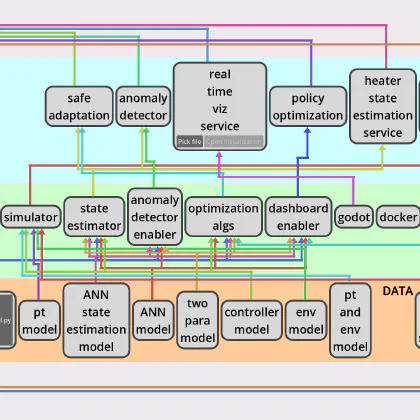
The development of a digital twin brings together many stakeholders and technical components. We have previously investigated the reporting of the conceptual architecture for these digital twins as an artifact for discussion. However, we find that the activity of modeling the digital twin for visualization and consensus-building can be quite tedious and time-consuming.
In this article, we explore the automation of model generation using large language models, targeting the model required for digital twin reporting. Our approach is designed to ingest digital twin documents and output both the conceptual architecture visualization and a reporting page for that digital twin. We first extract from the input the key details aligning with our twenty-one-characteristic Digital Twin Description Framework described in previous work. Then, we generate a description model in the Ontological Modeling Language, representing the digital twin as a constellation of models, data, enablers, and services. We utilize refinement loops with large language models acting as judges and ontological reasoning to increase artifact quality as measured by our metrics.
We investigate how architectural and parameter choices affect artifact quality, such as how refinement loops enable local large language models to produce sufficiently high-quality results comparable to larger models. We also detail insights and lessons learned useful for practitioners, such that they can integrate our techniques to accelerate their digital twin reporting or for other model generation tasks. These insights include the use of medium-sized local models (around 20 billion parameters), the avoidance of large language models as judges and clustering for characteristic extraction, and the recommendation of at least two reasoner loops for Ontological Modeling Language refinement.
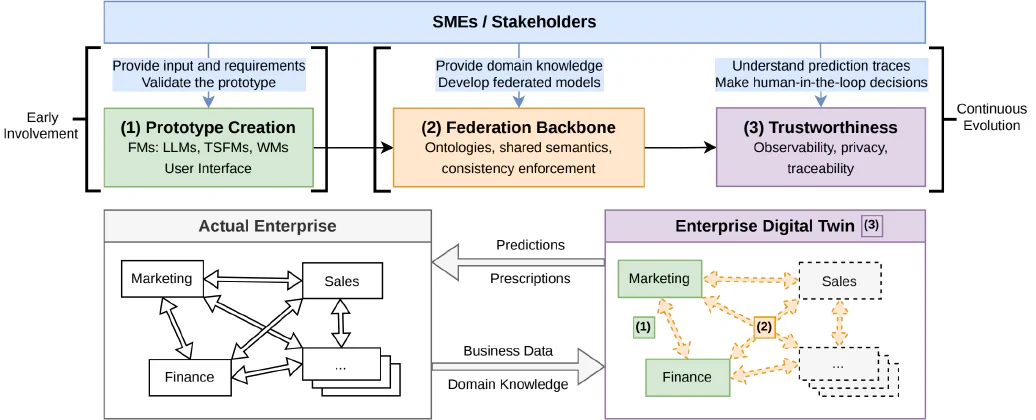
Involving before Evolving: A Vision for Trustworthy Enterprise Digital Twin Engineering
@inproceedings{Fiter2026,
author = {Fiter, K{\'e}rian and Lagrou, Adil and Oakes, Bentley and Dervault, Franck},
title = {Involving before Evolving: A Vision for Trustworthy Enterprise Digital Twin Engineering},
booktitle = {ACM/IEEE 29th International Conference on Model Driven Engineering Languages and Systems Companion (MODELS Companion)},
year = {2026},
month = oct,
pages = {1--5},
doi = {10.1145/3837062.3839094},
keywords = {Enterprise Digital Twin, Digital Twin, What-if Analysis, Uncertainty, Trust, Federation, Ontologies, Foundation Models, Large Language Models},
}
Promoting Observability in Digital Twin Reporting: A Hands-On Tutorial for DTInsight
Digital Twins (DTs) are evolving, complex software systems that require continuous stakeholder engagement throughout their engineering lifecycle. Yet, systematic and up-to-date reporting of DT characteristics and architecture remains challenging in practice.
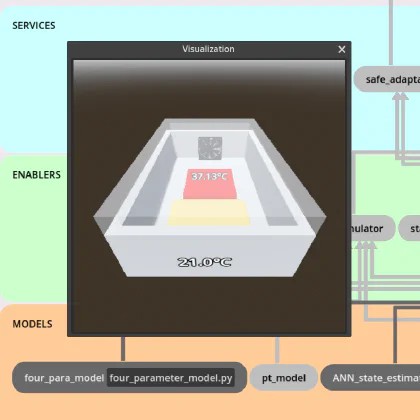
This tutorial introduces DTInsight: an open-source tool and methodology for producing explicit, interactive, and continuous reports for DTs. In 150 minutes, participants will learn to (1) model a DT using the 21 characteristics of the DT Description Framework (DTDF) ontology in the Ontology Modeling Language (OML) with Luxor in Visual Studio Code; (2) generate and explore an interactive “DT constellation” visualization reflecting the data flow between physical and digital twin components; and (3) integrate this reporting into a CI/CD pipeline so that the report page is automatically regenerated on every commit.
We also discuss how local LLM-assisted ontology generation with reasoner corrections can accelerate the initial modeling step, lowering the barrier for practitioners new to ontology engineering. By the end of the session, attendees will have built and deployed their own DT reporting page for a provided case study. Thus, they will acquire practical skills in ontology-driven DT description and continuous software documentation directly applicable to real-world projects.
DTInsight: A Tool for Explicit, Interactive, and Continuous Digital Twin Reporting
@INPROCEEDINGS{fiter2025dtinsight,
author={Fiter, Kérian and Malassigné-Onfroy, Louis and Oakes, Bentley},
booktitle={2025 ACM/IEEE 28th International Conference on Model Driven Engineering Languages and Systems Companion (MODELS-C)},
title={DTInsight: A Tool for Explicit, Interactive, and Continuous Digital Twin Reporting},
year={2025},
volume={},
number={},
pages={139-143},
keywords={Visualization;Three-dimensional displays;Systematics;Data visualization;Ontologies;Real-time systems;Software;Digital twins;Stakeholders;Monitoring;digital twins;software visualization;software documentation;decision-making;ontologies;OML;monitoring},
doi={10.1109/MODELS-C68889.2025.00030}}